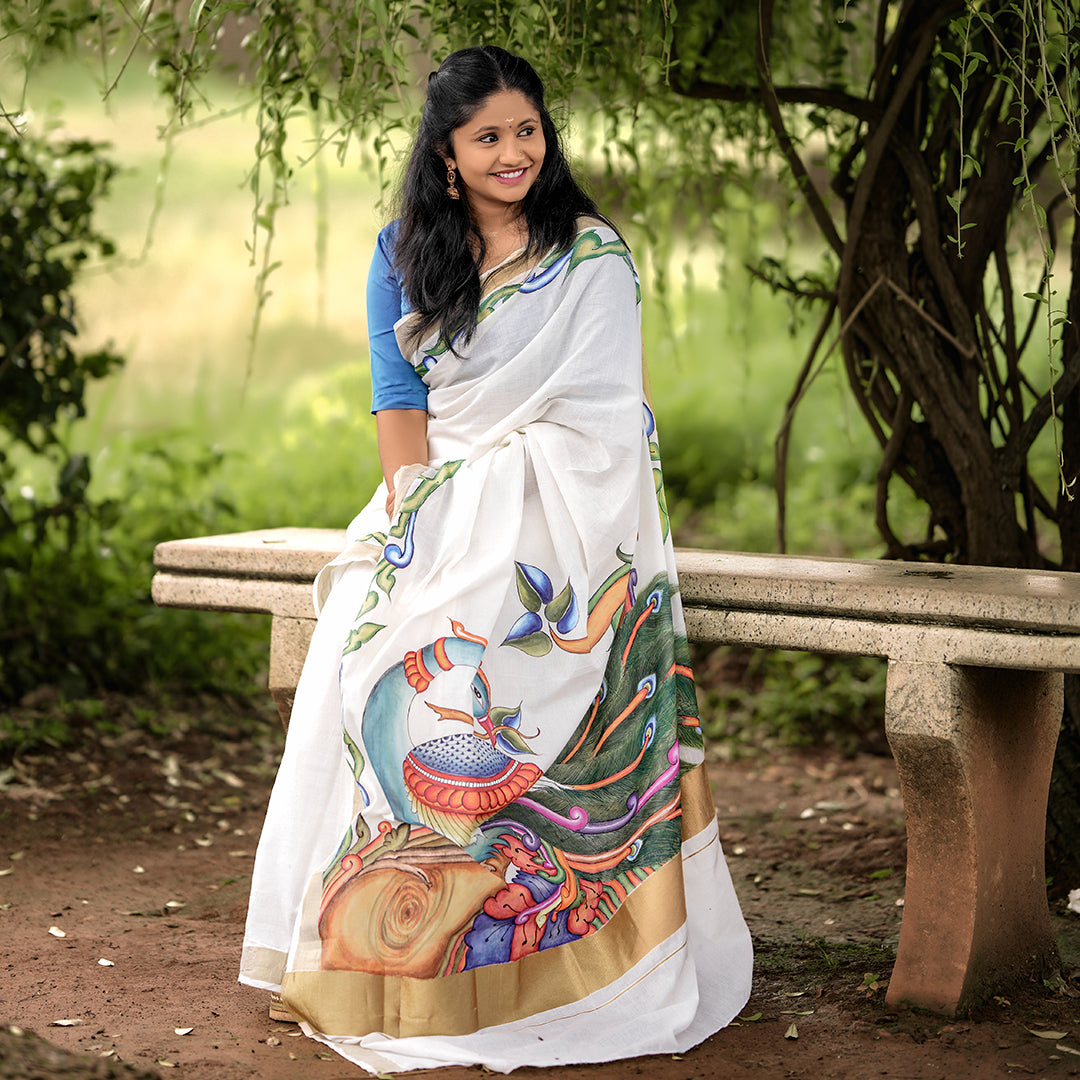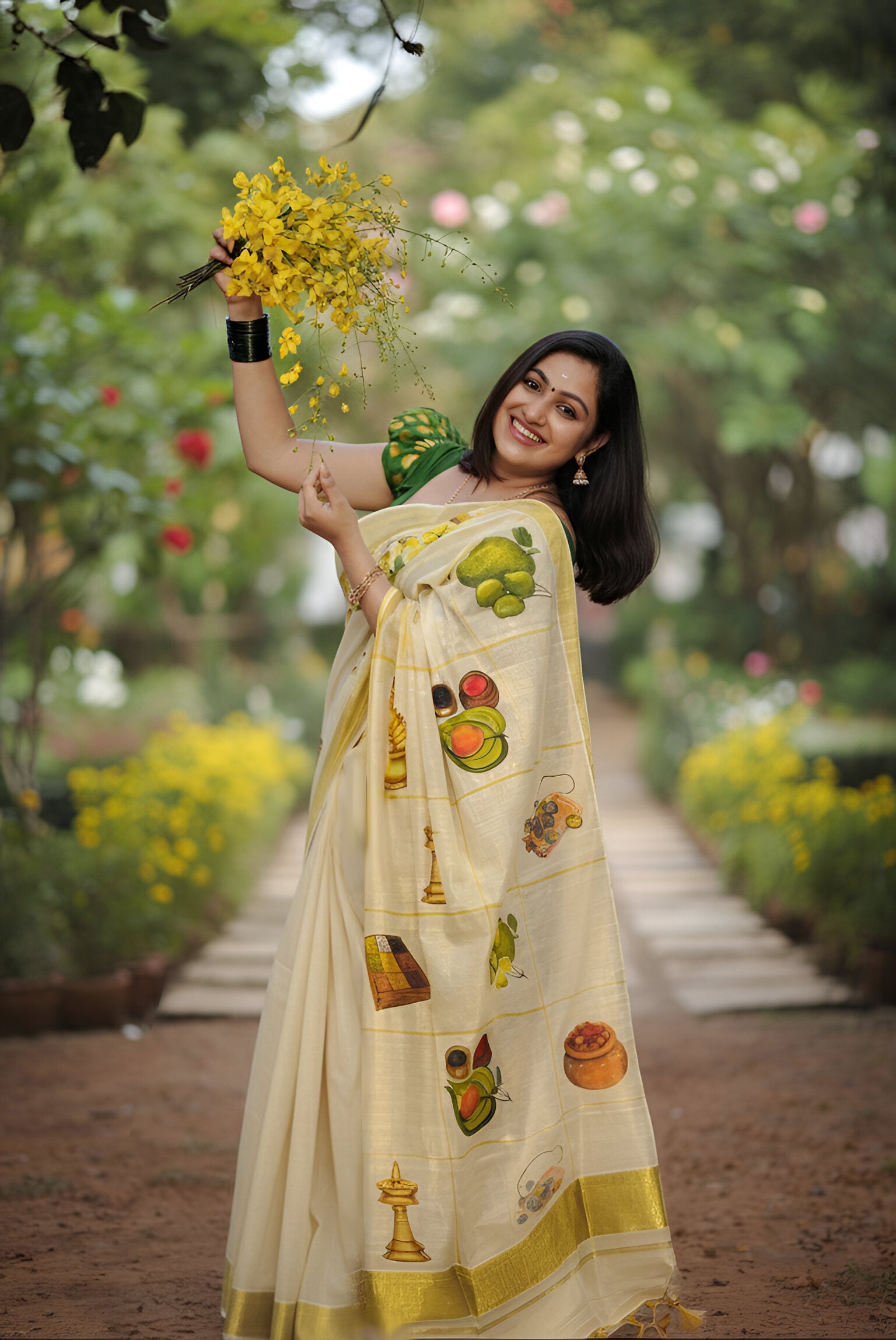

If you have been searching for hand painted sarees that are truly one of a kind not printed, not machine-made, not mass-produced you have arrived at the right place. At Fabus Frames, every saree is a canvas. Every brushstroke is a conversation between a skilled artist and centuries of living tradition.
This guide will walk you through everything you need to know about hand painted sarees in India: what makes them special, why hand painted cotton sarees deserve a place in every wardrobe, what the ancient tradition of Kerala mural saree painting looks like up close, and why mural painting sarees continue to captivate women across the world.
What Are Hand Painted Sarees?
Hand painted sarees are exactly what the name says- sarees on which designs are created entirely by hand, using fabric-safe paints, natural pigments, or acrylic colours applied with a brush directly on the cloth. No digital printing. No stencils. No shortcuts.
Each piece takes hours, sometimes days, to complete. The artist sketches the design, lays the base colour, builds up intricate layers, and finishes with fine detail work that no machine can replicate. The result is a wearable artwork that is completely unique: even if two artists paint the same theme, no two sarees are ever identical.
This is why hand painted sarees are not just fashionable, they are heirlooms.
Why Are Hand Painted Sarees So Special?
-
No two pieces are alike. Every saree you own is the only one of its kind in the world.
-
They carry cultural heritage. From Kerala mural motifs to Kalamkari patterns, each design has a story rooted in India's artistic traditions.
-
They support artisans directly. When you buy a hand painted saree from Fabus Frames, you are paying for a human being's skill, time, and livelihood not a factory's electricity bill.
-
They age beautifully. With proper care, hand painted sarees last decades and often become family treasures passed down through generations.
Hand Painted Cotton Sarees: Wearable Art for Every Day
Among all fabrics used for hand painting, cotton stands apart and hand painted cotton sarees are among our most beloved creations at Fabus Frames.
Cotton is breathable, lightweight, and drapes effortlessly. For artists, it is an ideal canvas: it absorbs pigment deeply, holds colour beautifully over time, and does not buckle under the detail work that hand painting demands. For the woman wearing it, cotton is practical, comfortable enough for long hours at a family gathering, elegant enough for a cultural event.
Why Choose Hand Painted Cotton Sarees?
For the climate: India's heat demands breathable fabrics. A hand painted cotton saree gives you the elegance of a painted masterpiece without the discomfort of heavier silks or synthetics.
For daily wear: Unlike silk sarees that feel too precious for regular use, cotton sarees are sturdy and wash-friendly (with gentle care). You can enjoy your art every day, not just on special occasions.
For sustainability: Cotton is a natural fibre. At Fabus Frames, we source ethically and ensure that the fabrics we paint on are as responsibly chosen as the art we create.
For versatility: A hand painted cotton saree can be draped traditionally for a festival, styled casually for brunch, or worn formally to a cultural programme it adapts to the occasion.
Our hand painted cotton sarees feature motifs ranging from delicate florals to bold Kathakali faces, from peacock spreads to abstract nature-inspired compositions. Each one is completed entirely by hand by our artists.
Browse our hand painted cotton saree collection at fabusframes.com/collections/hand-painted-saree
Kerala Mural Saree: Wearing a Temple Wall
If you want to understand what a Kerala mural saree truly is, close your eyes and picture the interior walls of a centuries-old Kerala temple Mattancherry Palace, Thrissur's Vadakkunnathan temple, the cave temples of Thirunandikkara. The walls are alive with figures: gods and goddesses in rich ochres, greens, reds, and blacks. Eyes elongated. Gestures precise. Every figure full of devotion and dignity.
Now imagine wearing that art on a saree.
That is the Kerala mural saree.
The History Behind Kerala Mural Painting
Kerala mural painting is a classical Indian art form that dates back over 1,500 years. Traditionally painted on the plastered walls and ceilings of temples, palaces, and churches in Kerala, these murals follow strict compositional rules drawn from ancient Sanskrit texts on art and architecture, the Chitrasutra and the Silparatna.
Figures are depicted with characteristic features: large, almond-shaped eyes; stylised hands in classical mudras; elaborate costumes and jewellery; and a colour palette historically made from natural pigments yellow from turmeric, red from cinnabar, green from plant extracts, black from lamp soot, and white from lime.
When this tradition migrated from temple walls to fabric, the Kerala mural saree was born.
What Makes a Kerala Mural Saree Different?
A Kerala mural saree is not simply a saree with Kerala-themed art. It is a saree painted by an artist trained in the authentic mural tradition, one who understands the classical proportions, the colour grammar, and the iconographic rules that govern how a deity or dancer must be depicted.
At Fabus Frames, our artists are trained specifically in Kerala mural painting. They do not copy from images. They paint from knowledge, understanding how Krishna's peacock feather must sit, how Kathakali's crown must be structured, and how Radha's posture conveys devotion.
Popular Kerala mural saree themes at Fabus Frames include:
-
Krishna-Radha the most beloved pairing in Kerala mural iconography
-
Kathakali dancers capturing the elaborate costume and dramatic expression of Kerala's classical dance-drama
-
Ganesha the auspicious remover of obstacles, rendered in classical mural style
-
Lotus and fish nature motifs that appear frequently in ancient Kerala temples
-
Buddha serene, meditative, painted in traditional mural tones
Each Kerala mural saree from Fabus Frames is painted on Kerala tissue or Kerala cotton, the traditional fabric of the region giving it an authenticity that goes beyond the art alone.
Mural Painting Sarees: A Tradition That Travels
Mural painting sarees is the broader category that encompasses not just Kerala's classical tradition but the entire world of sarees adorned with mural-style artwork. While the Kerala mural tradition is the most recognised and widely celebrated in this space, mural-inspired painting appears across India's textile heritage.
At Fabus Frames, mural painting sarees are our signature offering. Here is what distinguishes them:
Authentic Artist Collaboration
Every mural painting saree at Fabus Frames is made in collaboration with artists who have dedicated years, often their entire careers, to mastering the mural form. These are not hobbyists or generalists. They are specialists.
When you wear a Fabus Frames mural painting saree, you are wearing the work of someone who has studied the Chitrasutra, who has painted hundreds of devotional figures, who knows instinctively how the eye should flow across the composition.
Made-to-Order Customisation
One of the most powerful aspects of mural painting sarees is that they can be personalized. Want a specific deity? A particular scene from a classical story? A combination of motifs that holds meaning for you? Our artists can create it.
This is especially popular for:
-
Weddings bride sarees with customised bridal themes
-
Gifting a meaningful, one-of-a-kind gift for someone special
-
Milestone events anniversaries, retirements, personal celebrations
The Full Spectrum of Mural Painting Sarees
Our mural painting saree collection spans:
-
Kerala tissue sarees the gold-bordered traditional drape with mural painting
-
Cotton mural sarees everyday wearability with full traditional artistry
-
Customised mural designs your vision, our artist's hands
How to Care for Your Hand Painted Saree
A hand painted saree is an investment. With the right care, it will last a lifetime.
Washing: For the first wash, dry clean is strongly recommended. After that, gentle hand washing in cold water using mild detergent is safe. Do not wring or twist.
Drying: Always dry in the shade. Direct sunlight can fade pigments over time.
Ironing: Iron on the reverse side using low-to-medium heat. Never iron directly on the painted surface.
Storage: Store folded (not hung) in a clean cotton cloth. Avoid plastic bags, which trap moisture and can cause mildew.
Handling: Always handle with clean, dry hands. Oils and lotions can transfer to the fabric and affect the paint.
Why Choose Fabus Frames for Hand Painted Sarees?
Fabus Frames is not a marketplace or an aggregator. We are an art studio that makes sarees.
Every hand painted saree, hand painted cotton saree, Kerala mural saree, and mural painting saree in our collection is created by our team of trained artists, people whose skill we have invested in, whose work we curate, and whose livelihood our customers directly support.
With over 30,000 happy customers and a 4.9/5(1800+) rating, our commitment is simple: if you are not completely satisfied, we will redo the work or refund your amount. No questions.
What you get with every Fabus Frames saree:
-
100% hand painted no prints, no shortcuts
-
Unique piece never duplicated
-
Ethically sourced fabric
-
Artist-supported purchase
-
Customisation available on request
-
Reliable pan-India shipping
Explore the Collection
Ready to wear art?
Visit Fabus Frames to browse our full range of hand painted sarees, including hand painted cotton sarees, Kerala mural sarees, and mural painting sarees.
Each piece is waiting for the right person to carry it forward.